
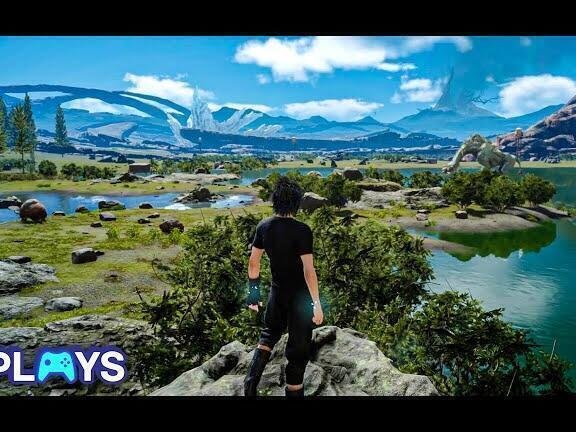
Open-world gaming has evolved dramatically, offering players vast, immersive landscapes to explore at their own pace. From sprawling cities to untamed wilderness, the scale of these virtual worlds continues to push the boundaries of interactive entertainment. In this list, we present the , highlighting the titles that deliver not just size, but rich detail and engaging gameplay across expansive environments. Whether you’re navigating post-apocalyptic wastelands or sailing uncharted seas, each game offers a unique sense of freedom. Join us as we explore the largest digital realms in gaming today, where adventure awaits around every corner—and the horizon is just the beginning.
Exploring the Largest Virtual Worlds in Gaming
The evolution of open-world game design has led to increasingly vast digital landscapes, allowing players to wander through expansive environments teeming with content, exploration, and immersive storytelling. As hardware capabilities improve, developers are pushing boundaries to deliver some of the most detailed and enormous game worlds ever created. Among current and past titles, there’s growing interest in discovering which titles rank among the Top 10 Open-World Games with the Biggest Maps. These games are not only notable for their sheer geographical size but also for how they utilize scale to enhance gameplay, quests, and player agency.
What Defines a Massive Open-World Game?
A massive open-world game is typically distinguished by the combination of map size, density of interactive content, and seamless exploration. It’s not just about how many square kilometers a map covers, but how effectively the space is used. Games in the Top 10 Open-World Games with the Biggest Maps often feature diverse biomes, dynamic weather systems, and non-linear progression that allow freedom of movement. Titles like The Elder Scrolls V: Skyrim and Red Dead Redemption 2 use scale to promote immersion, giving players the feeling of navigating a living, breathing world. Measurement criteria can vary—some count total map area in square kilometers, while others evaluate perceptible size based on travel time or region segmentation.
How Map Size Impacts Gameplay and Immersion
Larger maps in open-world games directly influence immersion and gameplay mechanics. In the Top 10 Open-World Games with the Biggest Maps, developers often incorporate varied transportation methods—such as horses, vehicles, or fast travel systems—to mitigate player fatigue. These expansive environments encourage exploration, often rewarding curiosity with hidden dungeons, rare loot, or narrative side content. However, map size alone doesn’t guarantee quality; empty or repetitive terrain can diminish the experience. The best titles balance scale with meaningful content, ensuring players feel engaged regardless of distance traveled.
Technical Challenges Behind Creating Gigantic Game Worlds
Developing the Top 10 Open-World Games with the Biggest Maps comes with significant technical hurdles. Rendering vast terrains in real-time requires efficient level-of-detail (LOD) systems, streaming technologies, and optimized asset loading. Games like Just Cause 3 and Microsoft Flight Simulator use procedural generation or real-world satellite data to manage scale. Moreover, ensuring consistent frame rates, minimizing pop-in, and maintaining physics coherence across large areas demand robust game engines and hardware optimization. Networking for multiplayer integration in expansive maps further compounds complexity, requiring precise syncing of player actions across massive virtual spaces.
Player Reception and Community Engagement in Large-Scale Games
Games featured in the Top 10 Open-World Games with the Biggest Maps often generate long-term community engagement. Players spend hundreds of hours exploring every corner, documenting glitches, completing 100% achievements, and sharing discoveries online. Titles such as The Witcher 3: Wild Hunt and GTA V have sustained active modding communities and multiplayer adaptations partly due to the richness of their maps. Streamers and content creators gravitate toward these games for their replayability and emergent gameplay moments, which are often born from the unpredictability of large, dynamic worlds.
Examples of Record-Breaking Open-World Sizes
Several games stand out as leaders in open-world scale. Xenoblade Chronicles X features a colossal alien planet, while Minecraft offers a virtually infinite procedurally generated world. Microsoft Flight Simulator uses real-world mapping data to recreate the entire planet’s surface, making it arguably the largest playable map ever created. Other notable entries like Eve Online and No Man’s Sky leverage simulation and procedural generation to create galaxies of explorable space. These titles exemplify the diversity of approaches used to achieve monumental size in gaming.
| Game Title | Estimated Map Size (km²) | Developer | Notable Feature |
| Microsoft Flight Simulator (2020) | 510 million (entire Earth) | Asobo Studio | Uses real-world satellite and photogrammetry data |
| No Man’s Sky | 18,446,744,073,709,551,616 planets | Hello Games | Procedurally generated galaxies with unique ecosystems |
| Eve Online | 230 billion km² (entire universe) | CCP Games | Persistent multiplayer universe with player-driven economy |
| The Elder Scrolls V: Skyrim | 37 | Bethesda Game Studios | Diverse Nordic-inspired landscape with dungeons and cities |
| Red Dead Redemption 2 | 47 | Rockstar Games | Highly detailed, immersive American frontier environment |
Frequently Asked Questions
What defines an open-world game with a large map?
An open-world game with a large map offers expansive, freely explorable environments where players can traverse vast landscapes without restrictive boundaries. These games emphasize non-linear gameplay, player freedom, and environmental immersion, often featuring diverse biomes, dynamic weather, and interactive ecosystems. The size of the map is complemented by the density and variety of content, including side quests, hidden locations, and seamless transitions between areas, making immersive simulation a core component of the experience.
Which game has the largest in-game map currently?
As of now, Microsoft Flight Simulator features one of the largest in-game maps due to its recreation of the entire Earth using real-world satellite data and AI-generated terrain. While not traditional in the gaming sense, its planet-scale environment allows players to fly anywhere on the globe, making it unmatched in sheer map size. Traditional open-world games like The Crew and Elden Ring also offer massive maps, but they are dwarfed by the global scale of flight simulators.
Are big maps always better in open-world games?
Not necessarily—while large maps can enhance exploration and immersion, their effectiveness depends on content quality and design. A vast map filled with repetitive tasks or empty spaces can lead to player disengagement, whereas a well-designed, smaller world rich in meaningful interactions, story depth, and environmental storytelling often provides a more satisfying experience. The best open-world games balance map size with engaging content to maintain player interest.
How do developers optimize performance in games with huge maps?
Developers use techniques like level of detail (LOD) scaling, streaming assets, and procedural generation to maintain performance in games with expansive maps. By loading only necessary data based on player location and reducing graphical complexity at a distance, games ensure smooth gameplay without sacrificing scale. Advanced rendering engines and memory management are crucial in enabling seamless transitions across vast terrains while preserving visual fidelity and frame rate stability.
