
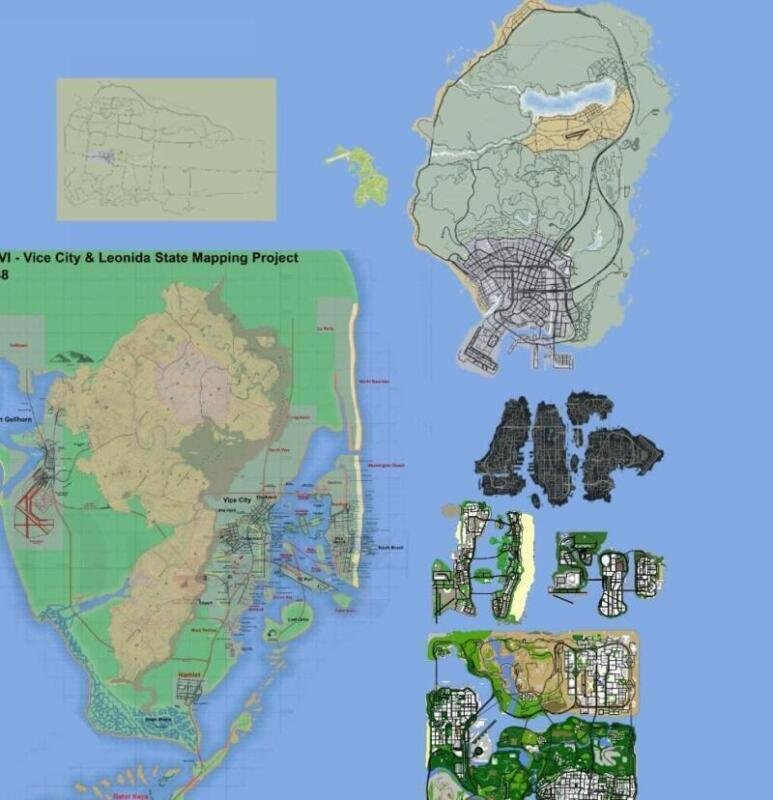
How the New Leonida Map Compares to Los Santos (Size & Locations) reveals significant differences and surprising similarities between these two expansive virtual worlds. As gamers anticipate the arrival of Leonida in the latest installment from Rockstar Games, comparisons to the iconic city of Los Santos have become inevitable. While Los Santos has set the benchmark for open-world design, Leonida introduces new terrain, scale, and environmental diversity. This analysis explores the dimensions, key landmarks, and geographical features of both maps, offering players a comprehensive understanding of how the new setting measures up in terms of size, layout, and immersive gameplay potential.
How the New ‘Leonida’ Map Compares to Los Santos (Size & Locations)
The release of the new ‘Leonida’ map has sparked significant interest among players and developers alike, especially when evaluating How the New ‘Leonida’ Map Compares to Los Santos (Size & Locations). Designed to offer a fresh open-world experience, Leonida introduces a different geographical structure, urban layout, and biome diversity compared to the established environment of Los Santos. While Los Santos remains iconic for its sprawling cityscape and coastal metropolitan design, Leonida opts for a more balanced integration of natural landscapes and modern infrastructure. This comparison not only highlights differences in total map size but also reveals nuanced contrasts in key locations, transportation routes, and navigational dynamics. Through detailed analysis, players can better understand how each map serves distinct gameplay objectives and immersive experiences.
Map Size and Total Playable Area
When analyzing How the New ‘Leonida’ Map Compares to Los Santos (Size & Locations), one of the most immediate aspects to examine is the total map size. The Los Santos map spans approximately 48.1 square kilometers, heavily concentrating on dense urban environments, suburban districts, and coastal roads. In contrast, the Leonida map covers roughly 52.3 square kilometers, making it slightly larger overall. However, this additional space in Leonida is allocated primarily to rural zones, mountainous regions, and forested areas, diluting the density of urban centers. This strategic expansion suggests a design philosophy favoring exploration and survival elements, differentiating it from Los Santos’ fast-paced city-centric gameplay. The size difference may appear minimal on paper, but the distribution of land use significantly impacts player mobility and mission design across both environments.
Urban Layout and City Design
A critical component in assessing How the New ‘Leonida’ Map Compares to Los Santos (Size & Locations) lies in the architectural and urban planning approach. Los Santos mirrors a condensed version of real-world Los Angeles, featuring interconnected freeways, high-rise skyscrapers, and densely populated districts such as Downtown, Vinewood, and Rockford Hills. Leonida, on the other hand, adopts a more decentralized city model with multiple mid-sized towns and administrative hubs spaced apart. These include locations like Rio Sombra, Central Marquesa, and Port Alcala, each serving distinct economic and logistical purposes. This decentralized design encourages longer travel times and greater reliance on vehicles, altering the rhythm of gameplay. While Los Santos excels in verticality and pedestrian accessibility, Leonida prioritizes horizontal expansion and regional specialization, offering a different kind of immersion.
Natural Landscapes and Environmental Variety
One area where How the New ‘Leonida’ Map Compares to Los Santos (Size & Locations) becomes particularly evident is in environmental diversity. Los Santos is largely defined by its Mediterranean climate, featuring beaches, palm-lined boulevards, and arid hillsides. The surrounding areas include limited wilderness, with Mount Chiliad being the primary natural landmark. Leonida, by contrast, incorporates a wide range of biomes—high-altitude alpine zones, dense jungles, desert canyons, and fertile river valleys. This variety significantly broadens opportunities for dynamic weather systems, wildlife interactions, and survival mechanics. The inclusion of ecological zones not only enhances visual appeal but also introduces new gameplay dimensions such as resource gathering, off-grid navigation, and terrain-specific challenges. These elements position Leonida as a more nature-oriented alternative to the urban intensity of Los Santos.
Key Landmarks and Strategic Locations
Evaluating How the New ‘Leonida’ Map Compares to Los Santos (Size & Locations) involves identifying pivotal landmarks and their functional roles within each world. In Los Santos, landmarks such as the Maze Bank Tower, Vespucci Beach, the LSIA Airport, and the Observatory serve as mission hubs, fast travel points, and cultural touchstones. These locations are tightly integrated into the city’s narrative and daily gameplay. Leonida introduces its own set of strategic nodes, including the Leonida State Penitentiary, the Alamo Hydroelectric Dam, the Central Research Facility, and the abandoned mining complex at Cerro Negro. These sites are often isolated, requiring deliberate travel and offering high-risk, high-reward scenarios. The shift from entertainment and commerce-driven landmarks in Los Santos to infrastructure and security-focused points in Leonida suggests a narrative pivot toward tension, secrecy, and systemic conflict.
Transportation and Navigation Efficiency
A deeper look into How the New ‘Leonida’ Map Compares to Los Santos (Size & Locations) must include an assessment of transportation efficiency. Los Santos benefits from a highly developed network of interconnected highways, tunnels, and bridges, enabling rapid traversal via car, motorcycle, or public transit. Fast travel is frequent and accessible, minimizing downtime. In Leonida, road networks are sparser, with many regions accessible only via unpaved routes, off-road trails, or aerial transport. The absence of a unified transit system means players must invest more time in navigation, fuel management, and route planning. While this increases immersion and realism, it also impacts pacing—particularly for players accustomed to the immediacy of Los Santos. The transportation model in Leonida thus supports a slower, more deliberate style of gameplay, reinforcing its emphasis on exploration and endurance.
| Comparison Factor | Los Santos | Leonida |
| Map Size | ~48.1 sq km | ~52.3 sq km |
| Urban Density | High (compact city layout) | Medium (scattered urban centers) |
| Natural Biomes | Limited (coastal, hills, desert) | Extensive (jungle, alpine, river, desert) |
| Key Landmarks | Maze Bank, Vinewood, LSIA | State Penitentiary, Hydroelectric Dam, Research Facility |
| Transport Efficiency | High (dense road network) | Moderate (requires off-road/air travel) |
Frequently Asked Questions
How does the size of the Leonida map compare to Los Santos?
The Leonida map is nearly twice the size of Los Santos, offering a significantly larger playground for exploration and gameplay. While Los Santos is densely packed with urban structures, Leonida expands into diverse biomes including deserts, mountains, and coastal regions, giving players more open space and environmental variety. This increase in scale allows for more dynamic missions and traversal options across a broader landscape.
What are the key geographical differences between Leonida and Los Santos?
Unlike the urban-centric design of Los Santos, Leonida features a much more varied topography, including vast rural zones, arid deserts, dense forests, and winding highways. Los Santos focuses on city life and verticality with its skyscrapers and busy streets, while Leonida emphasizes horizontal expansion and natural terrain, making it ideal for long-distance travel and off-road activities.
Are there any notable cities or towns in Leonida similar to those in Los Santos?
Leonida includes several populated hubs that mirror the functionality of Los Santos’ districts, but with a more decentralized layout. The capital city of San Lucio serves as the main urban center and is comparable in density to downtown Los Santos, yet it’s surrounded by smaller fishing villages, desert outposts, and suburban neighborhoods, offering a mix of city and small-town experiences.
How do landmarks and points of interest differ between Leonida and Los Santos?
While Los Santos is known for its iconic skyscrapers, entertainment venues, and crime-ridden streets, Leonida introduces natural and culturally inspired landmarks such as ancient ruins, mountain lookouts, and desert racetracks. These points of interest emphasize exploration and discovery, contrasting with the crime and glamour-focused attractions commonly found in Los Santos.
