
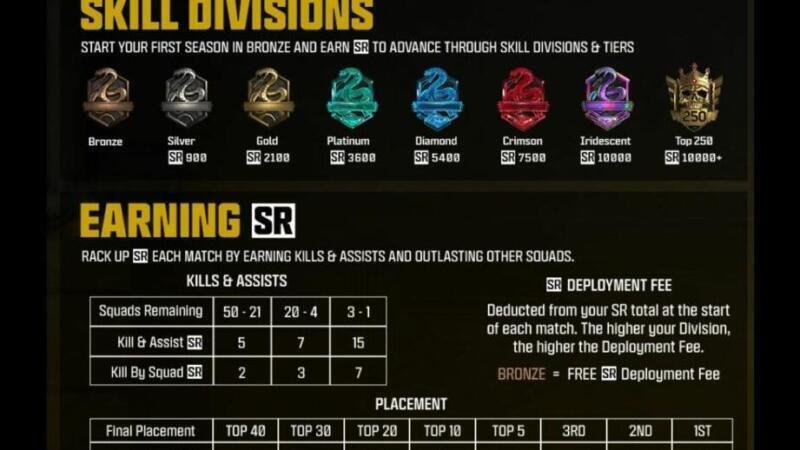
Understanding how Warzone’s ‘S-Based’ ranking system really works can be a challenge for even the most seasoned players. Designed to reflect skill progression across ranked modes, this tiered structure emphasizes performance-based metrics over simple win counts. From bronze to the elite S-Tier, each rank is determined by a hidden algorithm factoring accuracy, objective play, and combat effectiveness. Contrary to misconceptions, rank placement isn’t solely about victories, but consistent high-level contribution. This article breaks down the mechanics behind matchmaking ratings, placement matches, and performance thresholds, offering clarity on how Warzone’s ‘S-Based’ ranking system really works to ensure fair and competitive gameplay for all.
Understanding the Mechanics Behind How Warzone’s ‘S-Based’ Ranking System Really Works
The competitive structure in Call of Duty: Warzone has evolved significantly with the introduction of its new ‘S-Based’ ranking system, moving away from traditional numerical tiers. How Warzone’s ‘S-Based’ Ranking System Really Works involves a dynamic algorithm that evaluates a player’s performance across multiple dimensions such as match outcomes, individual kills, revives, objective completions, and consistency over time. Unlike previous ranking models, this system accounts for both personal skill and team-based contributions, adjusting ranks incrementally based on performance trends rather than single-game results. This approach is designed to offer a more accurate reflection of a player’s true skill level, reducing the volatility commonly associated with ranked play in battle royale environments.
What the ‘S-Based’ Rank Tiers Represent
The ‘S-Based’ ranking system in Warzone is structured around letter-based tiers, starting from Bronze and ascending through Silver, Gold, Platinum, Diamond, and culminating in the elite S and S+ ranks. Each tier is subdivided into levels (I, II, III, IV), requiring players to accumulate performance points to advance. These thresholds are not publicly disclosed, but progression is driven by consistent high-level play. How Warzone’s ‘S-Based’ Ranking System Really Works hinges on an internal MMR (Matchmaking Rating) that adjusts in the background, influencing both rank visibility and matchmaking placement. The system prioritizes gradual progression, discouraging rank inflation caused by short-term winning streaks.
How Performance Metrics Influence Your Rank
Players are evaluated using a comprehensive set of performance metrics that go beyond kill-death ratios. The algorithm considers objective contributions such as zone survival time, mission completions, drone usage, and even support actions like spot assists and supply box calls. High-impact but less visible actions contribute meaningfully to your performance score, which is then factored into your progression. This model ensures that players who contribute strategically, even without high kill counts, can still climb. How Warzone’s ‘S-Based’ Ranking System Really Works means that passive or overly aggressive playstyles alone are insufficient—balanced, team-oriented performance is key.
The Role of Matchmaking Rating (MMR) Behind the Scenes
Though the visible rank is letter-based, Warzone employs a hidden Matchmaking Rating (MMR) to determine competitive balance and progression pace. This numeric value adjusts after each match based on expected versus actual performance. If a player outperforms expectations—such as finishing in the top 10 with below-average kills—their MMR increases, accelerating rank gains. Conversely, underperformance leads to stagnation or even demotion across tiers. This hidden mechanism ensures that rank inflation is minimized, and players are consistently matched with opponents of similar skill. Understanding that How Warzone’s ‘S-Based’ Ranking System Really Works relies on MMR helps explain why some players experience faster climbs despite similar visible stats.
Seasonal Resets and Rank Calibration
At the start of each new season, Warzone implements a soft rank reset, which partially reverts player tiers to allow for recalibration. Players don’t drop to Bronze but are typically reset to a mid-tier based on their performance in the previous season. Calibration matches then reassess their current skill level before reapplying the full rank. This process prevents long-term stagnation and ensures that seasonal improvements are recognized. How Warzone’s ‘S-Based’ Ranking System Really Works includes this recalibration to maintain competitive fairness and incentivize continued engagement across seasonal updates.
Rank Visibility and Competitive Pressure
The public display of ‘S-Based’ ranks adds a layer of competitive visibility, motivating players to improve and demonstrate their skill. Unlike hidden ranked ladders, Warzone’s system lets players compare progress with peers, fostering accountability and ambition. However, this also introduces pressure, as rank becomes a public metric of performance. To mitigate frustration, the system includes protection mechanisms—such as demotion shields for consistent performers. Recognizing that How Warzone’s ‘S-Based’ Ranking System Really Works balances transparency with fairness helps players manage expectations and focus on long-term progression.
| Rank Tier | Subdivisions | Progression Requirement | MMR Influence |
| Bronze | I, II, III, IV | Entry-level performance | High adjustment sensitivity |
| Silver | I, II, III, IV | Consistent match participation | Moderate MMR shifts |
| Gold | I, II, III, IV | Top 40% finishing rate | Balanced feedback loop |
| Diamond | I, II, III, IV | Top 15% with strong K/D | Low volatility |
| S and S+ | Elite | Top 1% performance consistency | High stability, minimal decay |
Frequently Asked Questions
How does Warzone’s ‘S-Based’ ranking system determine player tiers?
The ‘S-Based’ ranking system in Warzone assigns player tiers based on performance metrics such as kill-death ratio, mission completion, and survival time. Unlike traditional ranked modes, this system dynamically adjusts your tier by analyzing in-game behavior across multiple matches, rewarding consistent high performance with higher tiers like S, A, or B, while poor results can lead to demotion.
Does the ‘S-Based’ system use skill-based matchmaking (SBMM)?
Yes, the ‘S-Based’ ranking system integrates skill-based matchmaking (SBMM) to pair players of similar performance levels. Your matchmaking rating (MMR) is calculated behind the scenes, ensuring you face opponents with comparable stats and win rates, which helps maintain competitive balance and fairness in each lobby.
Can I see my exact rank or MMR in the ‘S-Based’ system?
No, players cannot view their exact MMR or numerical rank in the ‘S-Based’ system. Instead, Activision displays only a letter-based performance tier (such as S, A, B) that reflects your recent gameplay consistency and overall skill level, designed to prevent rank obsession while still providing performance feedback.
How often does the ‘S-Based’ ranking system update my tier?
The system recalculates your tier after every match based on real-time performance data, including placements, eliminations, and objective contributions. While minor fluctuations happen immediately, significant tier changes typically require sustained performance over several matches to ensure stability and accuracy.
